The customer has decided before you call
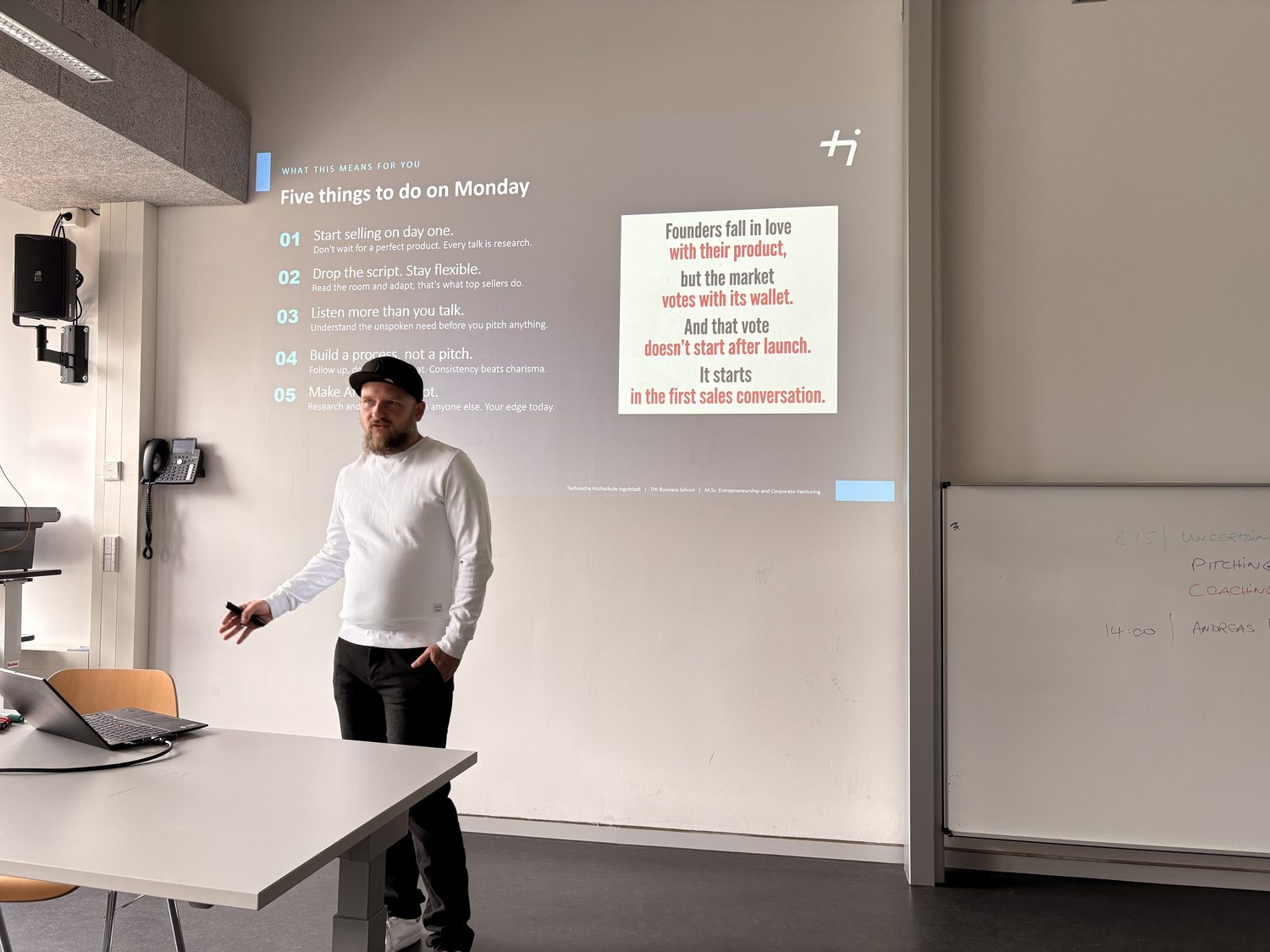
In June I stood in front of students at Technische Hochschule Ingolstadt, on the entrepreneurship programme. Young people who want to found a company. My job was to tell them something about B2B sales.
I opened with a number, and it changed the mood in the room.
The number
Fifty-seven per cent of the buying process is behind the customer before a supplier is contacted at all. The figure comes from a study by the CEB Marketing Leadership Council together with Google, around fifteen hundred B2B buyers surveyed. I came across it in Claudia Thonet’s book on agile sales.
What matters is what the number says and what it does not. It does not say the decision has been made. It says how far the customer has come in their own process before they call you.
I put the number on the wall and asked what that means for their sales.
The first answer was: then we simply have to call earlier.
That is the obvious answer, and it is wrong.
Why calling earlier does not help
The customer does not inform himself earlier because he is looking for a meeting. He informs himself earlier because he can. He reads comparison sites, watches videos, asks his network, downloads trial versions. He does that at his own pace and without you, and that is not rejection, it is simply more comfortable.
If you call during that phase, you are interrupting. You do not get a conversation, you get a defence.
And if you call afterwards, the process has run a long way. Nothing has been decided by that. But a good deal has been set in motion: which two or three vendors come into question at all and what they will be measured against. The criteria are set. And usually somebody else wrote them.
That is the actual point. Not that you arrive late. But that you walk into an evaluation whose yardstick you had no part in shaping.
And you are not sitting opposite one person
On top of that comes the second number, and it does not make things easier. Buying committees on the customer side today often consist of six to ten people. Gartner recorded that in its research on software buying, and it matches everything I see in the enterprise segment.
Six to ten people. With different interests, different levels of knowledge and different reasons why the project is allowed to fail.
The head of IT wants it to work. Procurement wants it to be cheap. Data protection wants it to hurt nobody. The works council wants to know whether it will be used to measure performance. The business unit wants its daily work not to get worse. And somewhere sits the person who holds the budget and was in none of your meetings.
You usually speak with one or two of them. The others hear about you second hand.
The actual test
From that follows something I marked as the most important sentence in the lecture.
The test for a good sales conversation is not whether the person opposite nods at the end. The test is whether they can retell what you said internally, themselves, two weeks later.
Because that is exactly what happens. They sit in a room you are not in and have to explain in three sentences why you of all vendors. If they need your slides for that, you have lost. If they need a product data sheet, you have lost too.
They need one sentence they have remembered, because it describes their problem and not your product.
What that means in practice
I gave the students five things to take away. Three of them apply just as much to any grown sales organisation.
Start selling on day one, even without a finished product. Every conversation is market research. You learn which words your customers use, and those words are your arguments later.
Put the script down. The average salesperson works through their sequence. The good one reads the room and picks from a repertoire. That is not a gift, it is practice, and it presupposes that somebody gives them the freedom for it.
Build a process, not a pitch. Follow up, document, repeat. Consistency beats charisma. That is the least romantic insight from twenty years in sales, and it is the most durable.
What really occupies me about this
The numbers are not new, and yet many organisations still work as though the first contact were the beginning of the buying process. It is not. It is a late checkpoint in a process that began without us.
Anyone taking that seriously stops optimising the first contact and starts being visible in the phase before it. With content somebody finds when they search. With people who are reachable in the network. With cases somebody can retell.
That is uncomfortable, because it cannot be set up in a week and because it shows up in the forecast only late.
At the end of the lecture somebody asked me what the most important piece of advice was. My answer was: keep it simple. Customers do not buy features, they buy outcomes. And if you cannot state your outcome in one sentence that a stranger can repeat, then you have not understood it yourself yet.
How do you deal with the fact that the buying process begins without you?

I build sales organisations in the B2B software business and write here about what actually works. Disagreement is welcome, preferably on LinkedIn.
Read on
Sales Transformation
Good people don't leave a transformation. They leave a bad one.
That the good people leave first in a transformation is only half true. Often it is the other way round, and the transformation is needed because they have already gone. Why those who stayed are not the leftovers, and how a single conversation in my first leadership role made everything that followed possible.
Sales Transformation
Pay for the old and you get the old.
The target state is in place, everyone nods, and sales still works the way it always has. As long as the target system pays for the old behaviour, the transformation remains reversible. When to touch the target system, why it is decided by the classic conflict between new business and existing customers, and how to manage the transition without the team experiencing it as an attack on their income.